Review
Pimsleur German review
What learners report about Pimsleur for German: unusually good pronunciation, thin vocabulary, and a clear ceiling.
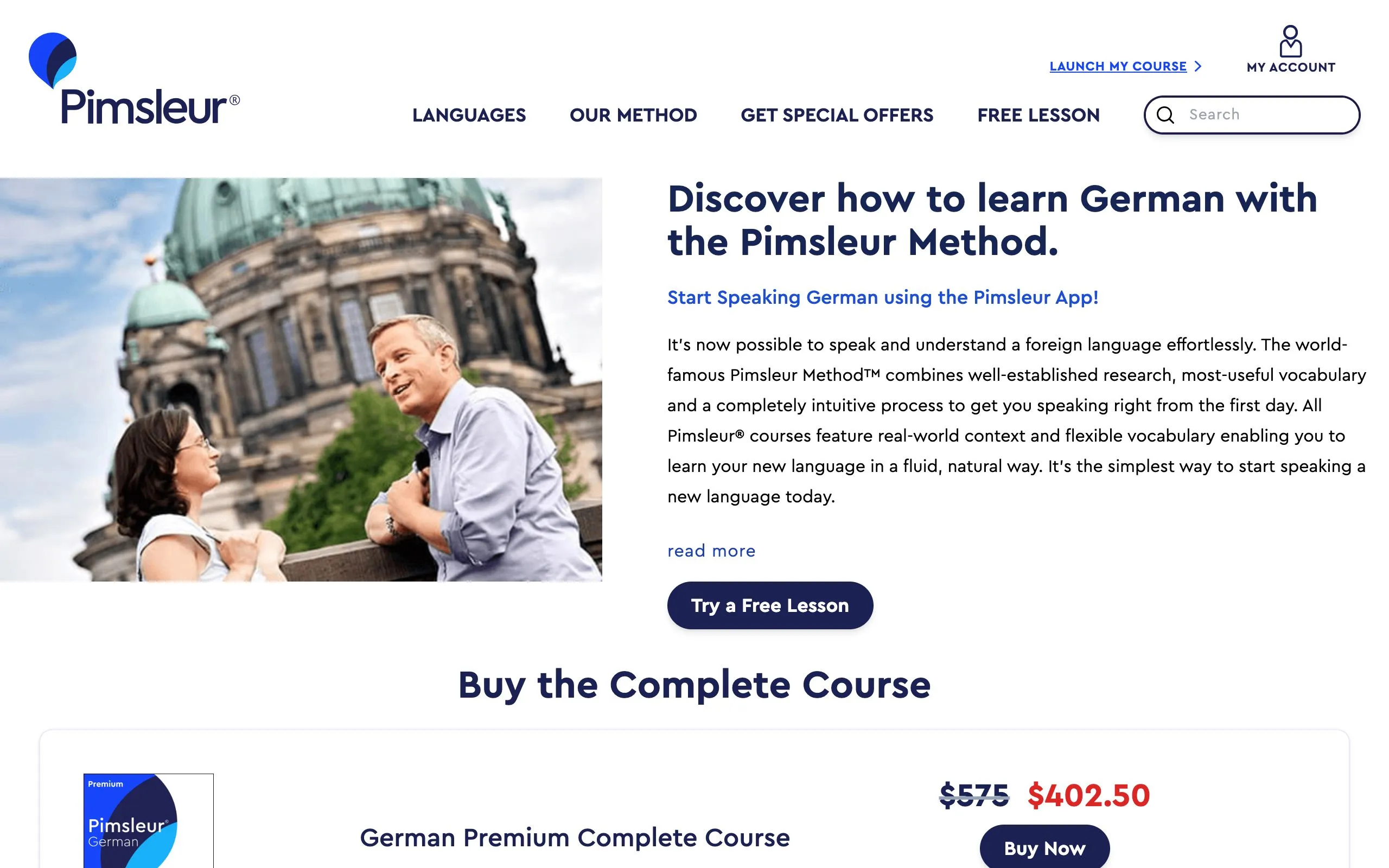
Pimsleur is an audio course. You listen, a narrator prompts you in English, and you answer out loud in German before the recording gives you the correct version. Lessons run about thirty minutes, there are five levels of thirty lessons each for German, and the method is built on recalling material at widening intervals. It is one of the oldest products in this market and one of the few designed to be used with your hands busy and your eyes elsewhere.
Verdict. The best tool there is for German pronunciation, and close to useless for most of what you need alongside it.
Best for commuters and auditory learners who want to be speaking from day one and will get vocabulary and grammar somewhere else.
Less suitable for anyone who wants to read or write German, who needs grammar explained rather than absorbed, or who expects one product to carry them past A2.
At a glance
| Dimension | Band | Why |
|---|---|---|
| Speaking | Good | Forces production aloud from the first lesson, which is the barrier most learners name |
| Listening | Good | Consistently reported to improve, within the course’s narrow subject range |
| Vocabulary | Weak | Small and oddly chosen; near-universally the first thing people supplement |
| Grammar | Weak | Structures are absorbed rather than explained, and learners struggle to generalise them |
| Reading | Weak | Some phonetic reading lessons in Premium, but reading is not what the course does |
| Writing | None | Absent entirely |
Pronunciation is not a CEFR skill of its own, which undersells this course. It is the thing Pimsleur is best at, and it sits inside Speaking above.
What learners consistently praise
Pronunciation, more consistently than anything else. Learners who agree on nothing else about Pimsleur agree on this. One learner who finished all five levels said the method fixed sounds they had struggled with, naming fahren, sicher and the run-together of schon gross as things that were solid by the end. Two people report being told by Germans that their accent was good, and a nurse who used German with a patient after four months said both the patient and a tutor understood everything and remarked on the accent (r/German).
It makes you speak out loud from the first lesson, alone, with nobody watching. Learners repeatedly describe this as the thing that got them over the barrier that stops most people. One put it as being able to think and respond in German without needing another person or risking embarrassment (r/German).
What it teaches sticks unusually well. Someone who used Pimsleur for Russian a decade earlier said the only Russian they had left was the Pimsleur material. Another reported the same for Greek years later. This is what the spaced-recall method is for.
Case endings start arriving without conscious effort. A learner partway through level 3 described producing a sentence they had never been taught, Wir möchten einen Weißwein bestellen, without stopping to reason out that Weißwein is masculine and the accusative therefore takes einen. A learner at level 4 found the course had given them a conditional past construction their A2 evening class was not scheduled to reach that term, and called the course notably good for declensions (r/German).
It fits time that would otherwise be dead. Almost everyone who rates the course highly mentions a commute. That is not incidental praise; it is the reason the product survives its own weaknesses for these people.
What learners consistently criticise
The vocabulary is small and strangely chosen. This is the most repeated complaint after the praise for pronunciation. One learner noted they had been taught the German for a branch manager but not the German for bread. Several describe the range as built for a business traveller: airports, restaurants, hotels, small talk. Everyone who finished the course says the same thing, that you will need a separate vocabulary source before you can hold a conversation about anything you care about (r/German).
Grammar is absorbed, not explained, and it does not always generalise. A learner who completed three levels said they did not remember learning much grammar. Another described getting through the basic and intermediate lessons still wondering how to put a verb into the past tense, because the course had never told them the rule, only the instances.
There is no reading and no writing. One learner pointed out the practical consequence: someone who did only Pimsleur might fail an A1 exam despite speaking at a higher level, simply because they had never dealt with the writing system.
The register is formal and the dialogue has aged badly. The course teaches Sie first and introduces du later. Beyond formality, one learner catalogued the recurring scenario in which a character asks another whether they are travelling alone, sometimes while a spouse is mentioned, and read the whole thing as written for a mid-century businessman looking for company. Two other learners recognised the pattern, one of them in Pimsleur’s Romanian course. It is a small thing that is hard to unhear once noticed.
You have to talk out loud, which is a real constraint on where you can use it. One learner named this as the reason they never got far; another said it only worked because they live alone and could talk to themselves while cooking. This is the sort of practical detail that decides whether a product gets used.
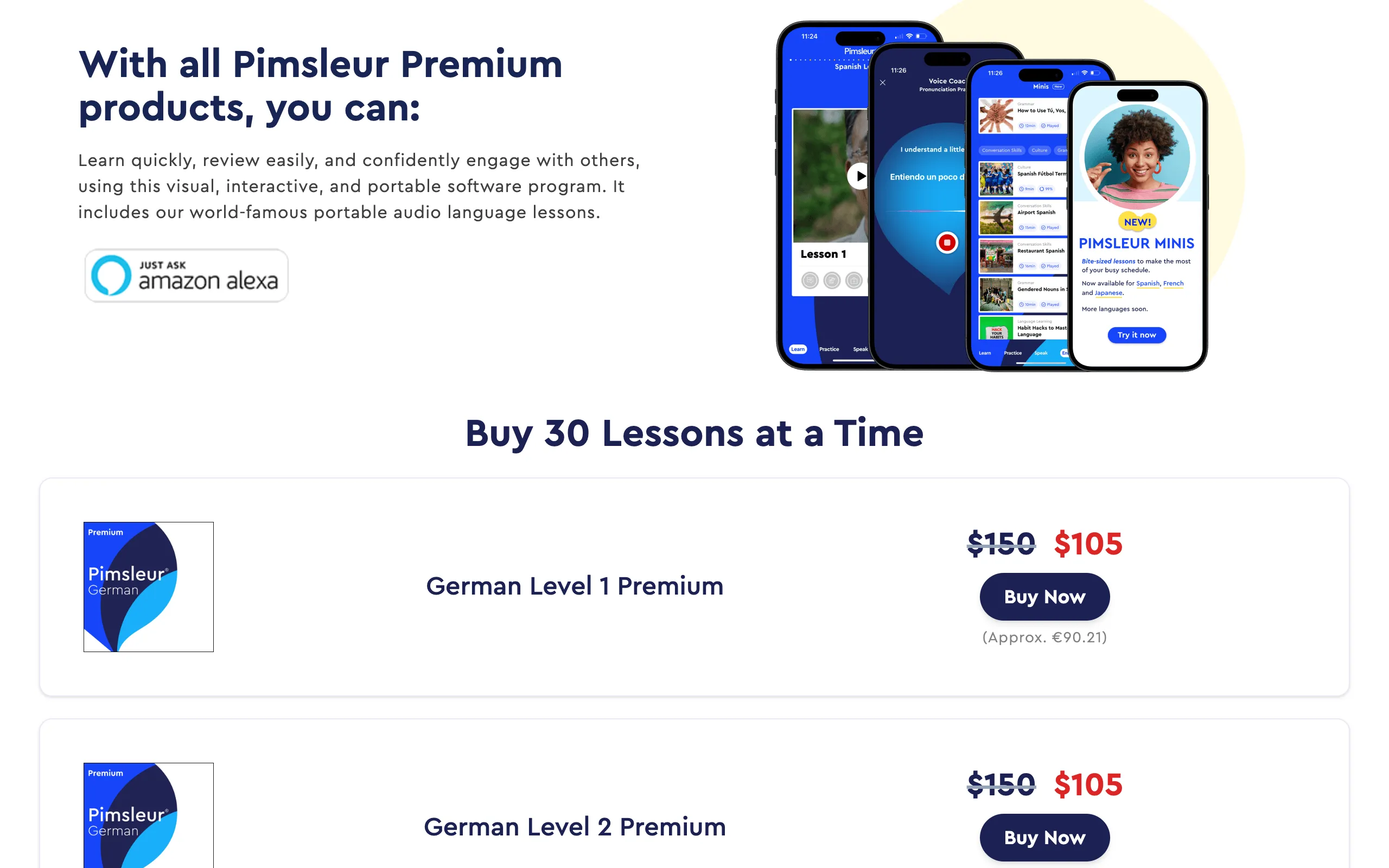
It is expensive, and the German course is sold in chunks. Five levels are sold separately at the same price each, with a discounted complete-course bundle. Learners routinely suggest borrowing it from a library instead.
Quality is uneven across the five levels. A learner partway through level 4 argued the course drops off after level 3, reasoning that the original method covered three units and the later levels are additions that feel less carefully built (r/German).
Where learners genuinely disagree
How far five levels actually gets you. This is the sharpest disagreement, and the answers span three CEFR levels.
One learner who completed the whole course said they came out with little conversational ability, though they could read signage and get themselves around and fed in a German city. Another puts the ceiling at a good A1. One learner lands on roughly A2 for speaking and listening, noting the course teaches structures well beyond that level while lagging badly on the vocabulary needed to use them. Someone else says a strong B1 is reachable, but only in combination with other resources, and a learner who reached B2 in a year did so while also working through Assimil, which they rated the better programme of the two.
A C1 learner compared the numbers directly: Pimsleur’s own site puts the five levels at around 79 hours, while the Goethe-Institut’s guidance suggests 60 to 150 hours of instruction to complete A1 and 150 to 260 more for A2 (r/German). On those figures, a complete Pimsleur course is roughly an A1’s worth of hours. Much of the disagreement above dissolves once you notice that the people reporting higher levels were all using something else as well.
Whether teaching Sie first is a flaw or a design choice. The learner who raised it worried that formal-first would leave them unable to speak casually. A learner who finished the course argued it is pedagogically sound: you lay down the grammatical structures once, without simultaneously juggling two registers, and du arrives later along with some informal phrasing. Neither convinced the other.
How people who rate it actually use it
- Put it in a commute or another hands-busy slot. This is the single most common pattern among people who finished, and the reason the format survives its weaknesses.
- Run a separate vocabulary source alongside it from the start. Learners commonly pair it with Anki or a graded reader; nobody who finished thinks the course’s own vocabulary is sufficient.
- Expect to add grammar explicitly. Several people pair it with a textbook, a class, or a structured free course to get the rules the audio never states.
- Do not judge it on the first thirty lessons. One learner notes level 1 stays deliberately simple and the course only opens up from level 2.
- Pair it with a free structured course. Learners commonly run it alongside something that covers the reading, exercises and grammar notes Pimsleur leaves out. Nicos Weg is the usual choice, and it is free. One learner working through both said no single programme was going to get them all the way on its own (r/German).
- Borrow it before buying it. Libraries often carry the course, and it is the cheapest way to find out whether the format suits you before committing to five levels.