Best of
Best German graded readers for beginners
The CEFR level on the cover means something different in every range. Four A1 and A2 series, and which one to buy first.
A graded reader is a story written from scratch inside a fixed vocabulary and grammar range, rather than an existing book cut down to size. The free alternative most beginners try first is a children’s book, and in German that is harder rather than easier. Books written for German children assume the vocabulary of a native six-year-old and tell their stories in Präteritum, a tense most A1 courses leave until much later. Picture books aimed at four to seven year olds defeat learners who can already follow a reader written for their level (r/German). The other common shortcut is a translation of a novel you already love. Measured on English readability scales, the first Harry Potter book scores above A Tale of Two Cities, and learners are pointed at it constantly (r/languagelearning).
The working rule learners settle on is roughly five unknown words per page, which is also the guideline used for children reading in their first language. Enough to be learning, few enough that the plot still pulls you forward. Past about ten, reading becomes decoding, the looked-up words do not survive the hour, and the book gets abandoned. LearnOutLive and Klett both put sample pages online, and a page of the real text tells you more than the level on the cover does. Hueber and Teach Yourself do not, so those two are bought unseen.
Verdict. Dino lernt Deutsch is the series to buy first, and the CEFR level printed on a cover tells you about the publisher rather than about you.
Best for readers who have finished a first pass at A1 and want a story instead of another exercise.
Less suitable for anyone who wants news or non-fiction, where free simplified German already does the job better.
At a glance
| Reader | Level | Best for |
|---|---|---|
| Dino lernt Deutsch | A1 to A2 | a first whole book, on the cheapest terms available |
| Klett leicht und logisch | A1 to A2 | learners who want audio and exercises in the same package |
| Hueber Lese-Novelas | A1 | adults who want a story with no exercises attached |
| Short Stories in German for Beginners | A2 to B1 | the reader after your first one, not your first one |
Those levels are the publishers’ own. A book badged A1 by Hueber and a book badged A1 by Klett were graded by different houses to different in-house standards, and where a sample exists it tells you more than the badge does.
The prices run opposite to the difficulty: the cheapest book here is the easiest and the most expensive is the hardest. Buying in ascending price order gets you the right sequence by accident. Buying the book with Beginners in its title first costs five times as much for the one to read second.
Dino lernt Deutsch
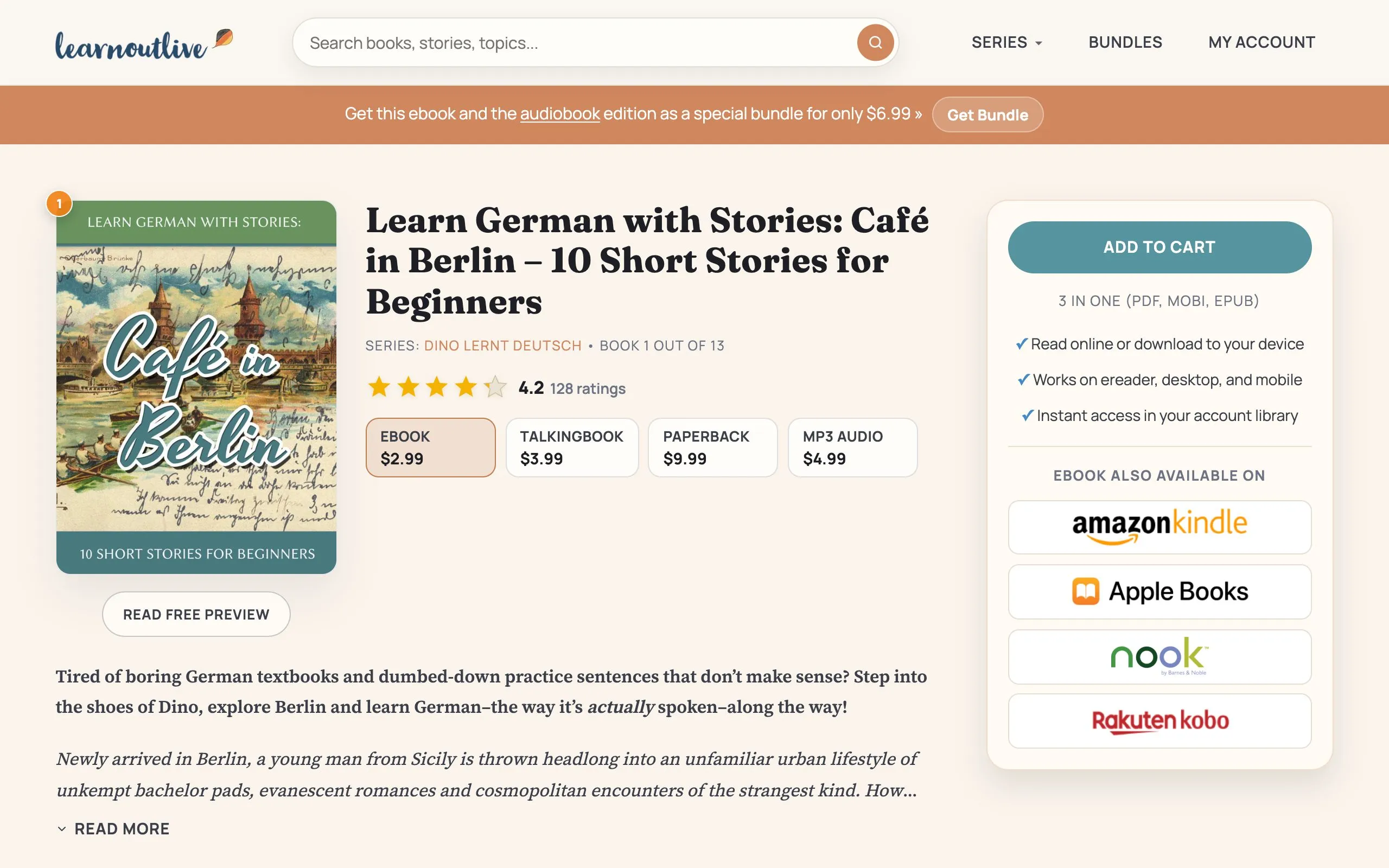
This is the series beginners actually finish, and at 2.99 US dollars for the ebook it is much the cheapest of the four. Dino is a young Sicilian who moves to Berlin, and each of the thirteen books moves him to another city. Learners report completing the first book, Café in Berlin, while still working through A1, in several cases as the first book they had ever finished in German (r/German). Every chapter closes with its own German-English glossary and a short comprehension quiz with answers, which is what makes it readable that early. The paperback is 9.99 and the MP3 audio 4.99.
Buy it from the publisher rather than from Kindle. The glossaries sit at the end of each chapter, and on the Kindle web reader consulting one means paging back and forth and waiting for each redraw, which reintroduces the interruption the glossary was put there to remove. The publisher’s own store sells the same book as a PDF, MOBI and EPUB bundle (r/German).
The audio is deliberately slowed for the first three books, and only reaches natural speed at book four. Learners starting the audiobook alongside book one describe the narration as very slow, and the change arrives with Momente in München. If you are buying the audio for listening practice rather than for following along, the early volumes will not give you much.
The series widens rather than climbs. Later titles move Dino to Frankfurt, Hamburg and beyond, but they stay at roughly the same level, so someone who has finished A2 and wants the next rung up will not find it inside this range (r/German). The ceiling arrives sooner than a thirteen-book run suggests.
Klett leicht und logisch
These are the only ones of the four that come with recorded scenes and exercises as standard. Each title runs about 56 pages, carries audio drama for the chapters and sets reading and listening comprehension exercises as you go. A learner who reached C2 rated the Klett readers at the top of everything they used below B1, working through eight of them and replaying the audio away from the desk (r/German). The print edition is 8.20 euros and the digital edition on the publisher’s platform is the same price.
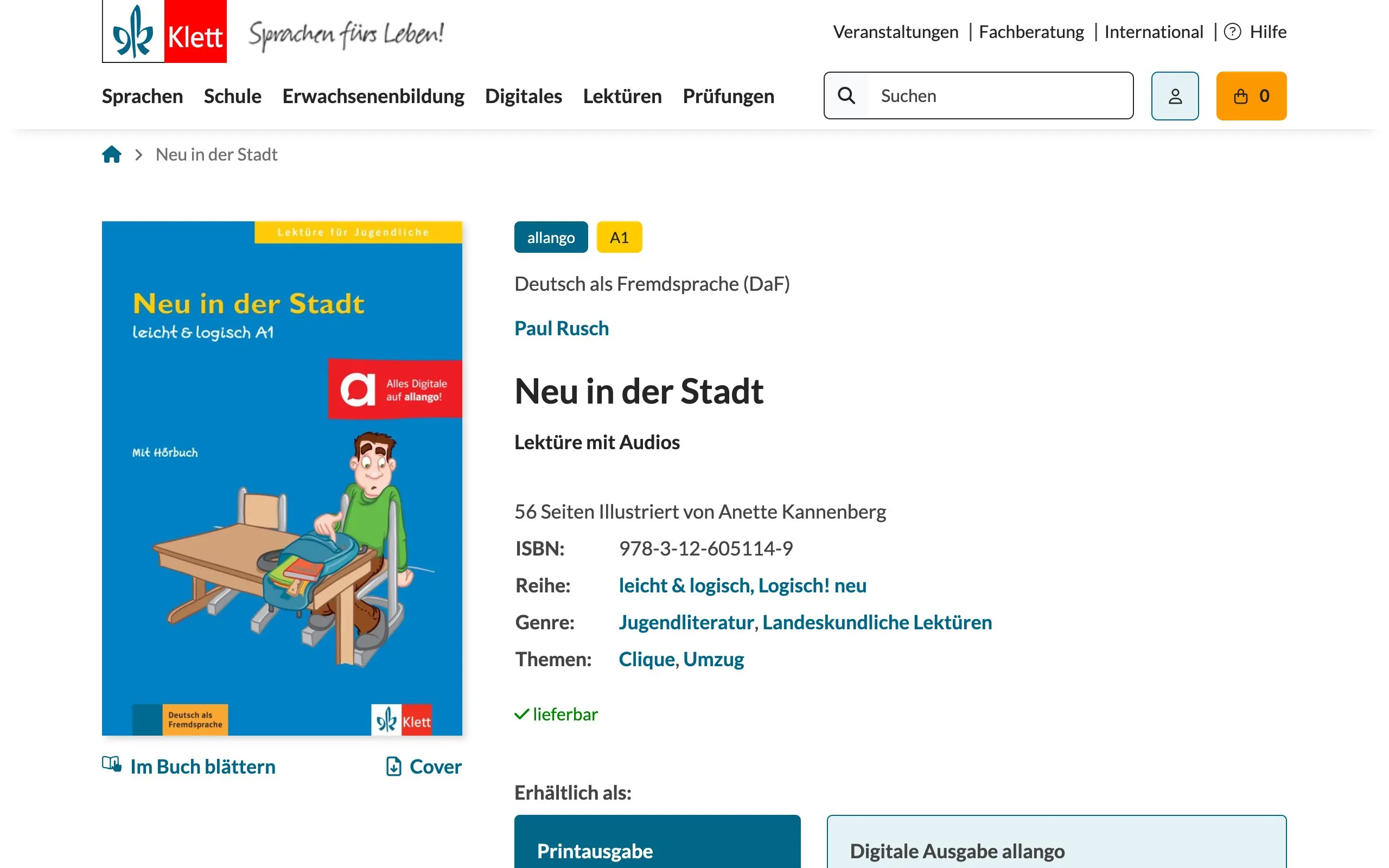
The A1 titles in this range are teen fiction. The cover says so, Lektüre für Jugendliche, and the catalogue files them under Jugendliteratur with subject tags for friendship groups and moving house. That suits some adult learners and grates on others, and either way it is visible before you pay.
A recommendation to read the Klett readers is not yet one you can act on. Klett publishes several parallel reader lines for German as a foreign language, and the learners who rate them most highly often cannot name the one they read (r/German). Start from a named sub-series rather than from the catalogue.
Hueber Lese-Novelas
Twenty-eight titles, all graded A1, all written for adults, and all sold as downloads. Adult subject matter, no exercises, no print edition. The text-only download is 8.00 euros and the edition with MP3 audio is 12.50.
The absence of exercises is a design decision, not an omission. The publisher describes the series as reading pleasure that is not dampened by didactic measures, and a learner who has collected several German reader lines reaches the same conclusion from the other direction, describing the Hueber books as just texts and ranking them last for that reason (r/German). Both are describing the same book accurately. Which of them is right depends entirely on whether you wanted homework.
At genuine A1 the German market offers two shapes and effectively no third: a teen story with audio and exercises attached, or an adult story with the apparatus stripped out. That is the choice worth ten minutes, rather than the level badges.
Short Stories in German for Beginners
The title says Beginners, and the publisher maps the book to A2 and B1. It sells for 14.99 US dollars direct and builds its eight stories from the thousand most frequent words, with a glossary for bolded terms, a bilingual word list, a plot summary and comprehension questions. Learners consistently place it above Café in Berlin in difficulty (r/German), and one who came to it at A2 while already speaking two related languages found both trivial (r/German). Read as the second reader rather than the first, it is well made and widely finished.
Do not confuse the book with the course sold under the same author’s name. StoryLearning is a separate product at a separate price, and learners who bought both rate them oppositely: the book gets credited with getting their eyes used to reading German at all, while the course draws the sharpest complaints about value (r/German). One is a cheap purchase and the other is not.
Readers who enjoy the series ignore the thirty-day structure. They report finishing a volume in two or three days rather than a month, and treat the range as a supply of cheap portable reading rather than a programme (r/German). Nothing is lost by doing that, but it changes what you are buying.
Where learners genuinely disagree
The live argument is whether a beginner should be reading at all, not which reader is best. One camp holds that reading below A2 is wasted effort, and tells learners arriving from a year or two of app study to go and finish a proper A1 course first (r/German). Learners who try a native novel at A2 and stall are routinely told the same thing, and pointed at a graded reader instead (r/German). The other camp is made up of people who did it anyway and finished a book at A1.
Part of that gap is a confounder rather than a disagreement. The learners who sail through an A2 reader at A1 tend to arrive already speaking another Germanic or Romance language (r/German). An English speaker with no third language should not read those accounts as a level benchmark.
The rest of the gap is genuine and unresolved. A separate line of argument holds that matching a reader to a level is a false precision in the first place, and that the only question that matters is whether the book keeps you reading, tolerating any number of lookups as long as it does (r/languagelearning). Both positions have people behind them who got to B2.
There is also a route around the whole question. If what you want is non-fiction rather than story, German has an unusually good free supply of simplified news, and beginners point each other to it constantly: a weekly simplified news site, an A2 news strand from Deutsche Welle, and simplified editions from both the German and Austrian public broadcasters (r/German). None of it costs anything, and at A2 it is stronger material than any of these four.
How people who rate them actually use them
- Read a sample before paying where one exists, and judge it by unknown words per page rather than by the level badge (r/German).
- Pair the reader with the audio and play it away from the desk, on a commute or while cooking, once the text is already familiar.
- Underline unfamiliar words rather than stopping to look each one up, so the reading flow survives the chapter (r/German).
- Borrow before buying where you can. A Goethe-Institut library membership lends graded material and learner magazines digitally for a small annual fee (r/German).
A reader is input, not a course. None of these four will teach you the case system or get you speaking. Nicos Weg is the free A1 to B1 course learners send each other to, and its opening chapters are the quickest way to check whether your German is ready for a book. If you have come here after a long run on Duolingo and found the first page of a reader impossible, that gap is the expected one rather than a personal failure, and the A1 guide sets out what a first course has to cover before reading gets comfortable.
Sources
- Where can I find A1/2 graded readers?, r/German
- Good easy German books for a beginner?, r/German
- Read my first book in German, r/German
- Question on graded readers, r/languagelearning
- A review of every resource I used to learn German from A1 to C2, r/German
- German books or short stories for A2-B1?, r/German
- More difficult series like Café in Berlin, r/German
- Is it a good idea to start reading books in German at A2?, r/German
- LingQ and Olly Richards, r/German
- Ich will deutsche Nachrichten in einfacher Sprache lesen und hören, r/German
- Wie bestimmt man Lesen Stufe für ein Buch?, r/German
- Deutsch perfekt magazine opinions, r/German