Review
Duolingo German review
Strong on daily habit and passive vocabulary, weak on grammar, and it teaches German nouns without their gender. Productive ceiling around A2.
Duolingo is a gamified course app. The German course runs as a single linear path of short exercises, mostly translating sentences in one direction or the other, with a streak counter and notifications built to bring you back the next day. Most exercises supply the words to build the answer from a word bank rather than asking you to type it, and the path is fixed, so you cannot skip material you already know. The whole course is free and ad-supported; the paid tiers remove the ads and the mistake limit rather than adding German. It is the default first stop for German learners in a way no other product is.
Verdict. A free course that reliably builds reading and vocabulary, and reliably fails to teach you to produce German.
Best for beginners who need a daily habit to stick, and who will get their grammar and speaking practice from somewhere else.
Less suitable for anyone who needs German grammar explained, who is meeting noun genders for the first time, or who is working towards speaking German by a date.
At a glance
| Dimension | Band | Why |
|---|---|---|
| Reading | Good | The skill learners most often report improving, up to subtitled television and simplified news |
| Vocabulary | Good | Large and well spaced, and the thing most often credited with better comprehension |
| Listening | Mixed | Improves against the app’s own recordings, then falls apart against fast or regional speech |
| Grammar | Weak | Taught by example; the written explanations are hidden and have been cut back over the years |
| Speaking | Weak | The course never asks you to build a sentence of your own, and its pronunciation feedback is distrusted |
| Writing | Weak | Word banks replaced most of the typing, and nothing longer than a sentence is ever asked for |
| Habit and motivation | Strong | The streak is what nearly every positive account is actually praising |
| Value | Good | The whole German course is free; the complaints attach to what the paid tiers add |
The bands describe the free tier, which is what nearly every learner is talking about. Reading and Speaking diverge because the exercises train one and never ask for the other.
What learners consistently praise
It gets people to show up, which nothing else in this market does. This is the most consistent praise, and learners usually offer it grudgingly. A learner switching away from the app said the streak counter and the notifications were the only reason they were doing any German at all, and asked for a replacement that would nag them the same way. Another described moving the streak to a flashcard app precisely to keep the do-not-break-the-chain feeling while changing what was inside it. A learner who kept it after starting a class described it as the thing that makes a daily habit survive a busy adult life (r/German).
Reading comes on faster than anything else. Learners who finished the course describe reading as the skill that carried over. One could read restaurant menus and station signs in Germany comfortably. Another, doing graphic design training in Berlin, reported reading newspapers and navigating German software menus while their conversation stayed rudimentary. A third can follow German television with German subtitles after finishing the course (r/German).
The volume of material, spaced out over time, does build a vocabulary. A learner who finished the course and returned to it in reverse, doing English from German while waiting for new units, credits the spacing with a marked improvement in comprehension and retention. A learner living in Germany at B2 who completed the whole course lists vocabulary building and daily engagement as its two real strengths, and is candid that both are limited (r/German).
It removes the friction that stops people starting. Learners repeatedly describe it as the thing that got them into German at all, against the alternative of doing nothing. A learner who works in a German-speaking job in Germany credits it as their starting point.
What learners consistently criticise
It teaches German nouns without their gender. This is the sharpest German-specific complaint and it recurs constantly, raised by native speakers and learners alike. A learner pointed out that vocabulary without gender is close to useless in German, because the gender is not an optional extra you attach later. A native speaker made the mechanical objection: prompted with the English word, you need to be able to answer der Tisch, with the article in front, because that is how you will need it when you speak, and the app trains you out of that. One learner completed the entire course and only then, by their own description too late, began writing new vocabulary down with its article (r/German).
Grammar arrives as a puzzle to be solved rather than a rule to be learnt. A learner most of the way through the second section reported learning essentially no grammar from the course while finding it useful for vocabulary and sentence practice. Another described relative pronouns, and um used to mean in order to, simply appearing inside exercises with no explanation attached. A learner who finished the course said it throws you into the fire and relies on your pattern recognition. Learners who eventually reached a real level describe adding a textbook, a class or a grammar reference to supply what the exercises never state (r/German). The paid app they most often move to for exactly this reason is Babbel, which explains grammar in writing rather than leaving it to be inferred.
You are never asked to produce a German sentence. The exercises translate in one direction or the other, and the word bank supplies the pieces. A learner named the consequence precisely: translating and composing are different skills, and the app only trains the first, so real-time conversation stays hard. A C1 learner who went back to try the lessons after reaching that level made the same objection independently. One learner noted the word bank hands you the correct article for free, which removes the very decision you needed to practise.
The pacing is set for you, and the repetition overshoots. The single linear path draws more complaint than any other design decision. Learners describe being unable to skip material they already know, being fed recently mastered concepts again at intervals too short to be useful, and spending an hour to acquire a handful of new words. One learner who finished the course found the later review sections consisted of the same sentences and fill-in-one-word exercises rather than anything new (r/German).
The vocabulary does not come back, and some of it was odd to begin with. A learner a few months in noticed that once a lesson is finished, most of its words never reappear outside the handful of high-frequency ones. A C1 learner put the selection problem bluntly: another animal is not what a learner needs, finding a doctor or ordering food is. A learner in Germany at B2 made the same complaint about phrases that are not what anyone actually says.
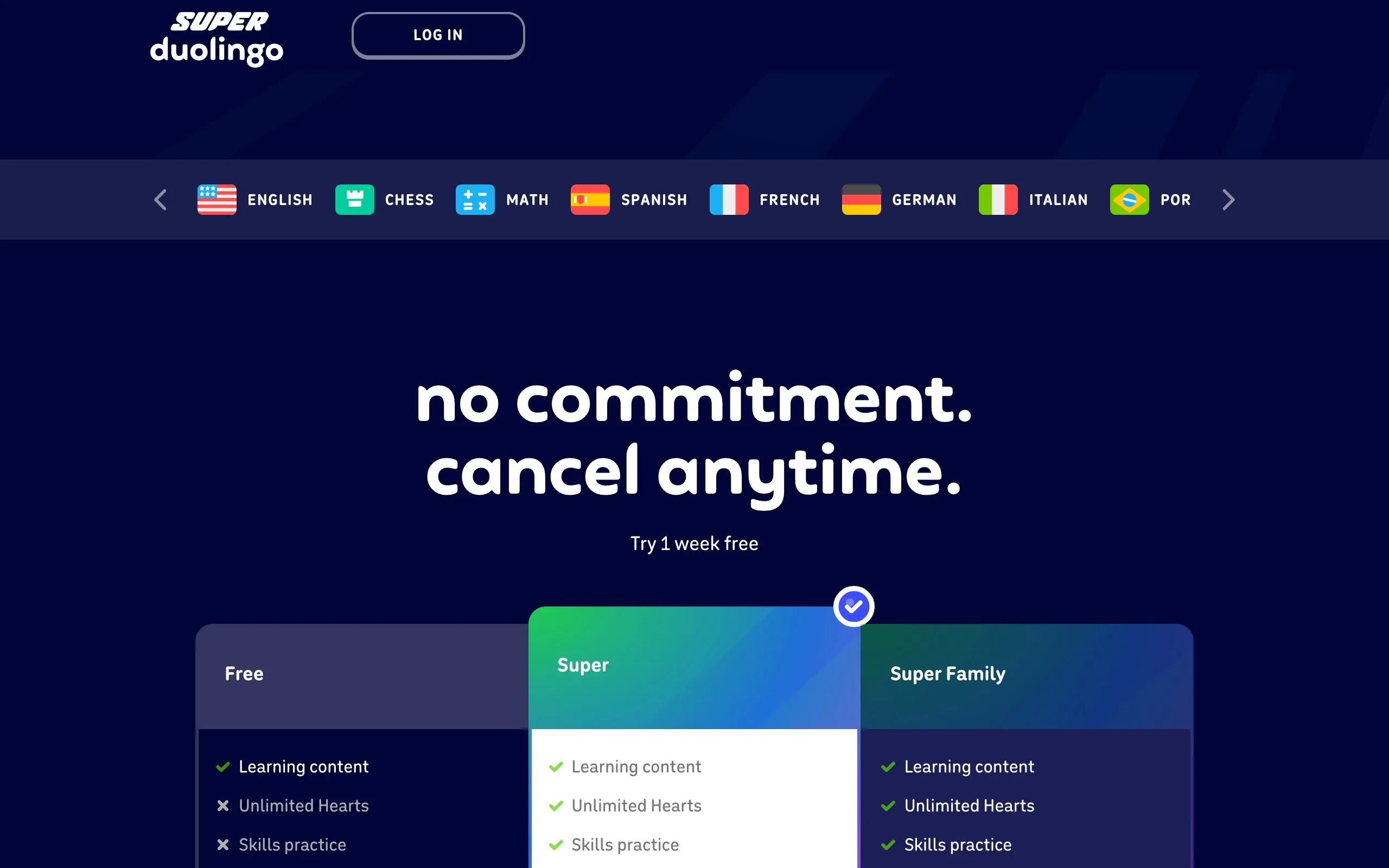
You cannot find out what it costs without signing up. The plan comparison names three tiers and lists what each includes, and there is no price on it. The public site carries no price anywhere, and neither do the App Store or Play listings.
A visible group left over the shift to AI-generated content. Learners cite the layoffs and the move to AI-produced material as their reason for stopping, and the phrasing is unusually consistent and unusually hostile. The complaint is about who is producing the material. It does not point at anything specific inside the German course (r/German).
Where learners genuinely disagree
How far the course actually gets you, and the answers span two CEFR levels. The course is built to end around the middle of B1. Learners who finished it and then had themselves measured report otherwise, and they do not agree with each other.
On one side: a learner who completed the course and then sat a placement test at a German language school landed in A2.1, well stocked with vocabulary and ready-made sentences and short of the whole of A1 grammar. A learner living in Germany who finished the course puts it at A2 at best. A learner who finished and travelled to Germany found the B1 claim did not survive contact with people speaking at normal speed.
On the other: a learner who used Duolingo alone sat a test at a Volkshochschule and was placed at B1, while adding in the same breath that they still needed lessons for grammar and vocabulary. Another passed the telc B1 exam having taken no German class at all.
The two camps are measuring different skills. Nearly every learner who reports a number also reports a split inside themselves: reading and listening at one level, speaking and writing a level below. One learner who finished the course put their own reading and listening at B1 and their speaking and writing at A2. Another said plainly that they read better than they write or speak. A third could read German signage fluently and was slow enough ordering food that the waiter switched to English. The high reports and the low reports are both accurate.
Whether the grammar explanations exist at all. Learners contradict each other flatly on this, and the contradiction has a cause. One learner reports the notes are decent and that most users simply never open them, because they sit in the corner of a unit header. Another looked repeatedly and found only examples with no explanation. A native speaker points out the fuller grammar sheets are on the desktop version rather than the app, which is not where most learners are. Two other learners, both long-term users, say the notes existed and have been progressively cut back. Two things are moving at once here, which platform you are on and which language you are learning from, and neither is signposted.
How people who rate it actually use it
- Open the grammar notes, and open them on the desktop site. The learner who asked whether the app was a waste of time had, by their own account, overlooked the notes entirely. The fuller material is on the web version, not the phone.
- Learn every noun with its article somewhere else. The recurring recommendation is a flashcard deck where the prompt answer is der Tisch rather than Tisch, plus the plural. One learner only began doing it after finishing the whole course, and calls that too late.
- Pair it with a free structured course that explains things. This is by far the most common piece of advice given to Duolingo users, and the recommendation is almost always the same one: Nicos Weg, which is free, covers A1 to B1, and does the explaining Duolingo does not. Learners who describe both usually run them together rather than swapping.
- Arrange speaking practice deliberately, because the course will not create it. One learner spends their walks narrating in German to their dog and looking up afterwards what they got wrong. Learners who name the same gap point to Pimsleur when the goal is being able to hold a conversation, on the grounds that it makes you speak aloud from the first lesson, which is the one thing Duolingo never asks for. Where the missing piece is grammar explained by a person rather than pronunciation, the recommendation shifts to a taught course, and the Goethe-Institut is the one learners name most.
- Treat the streak as the habit, not as the learning. The learners who get most out of it describe a deliberate division of labour: Duolingo holds the daily slot, and the actual course work happens elsewhere. One moved the streak itself into a flashcard app and kept the ritual while replacing the content.
Sources
- Has anyone here completed the Duolingo German course, r/German
- Is Duolingo that bad, r/German
- What exactly is wrong with Duolingo, r/German
- I finished Duolingo, English to German, r/German
- Is Duolingo still viable, r/German
- Duolingo 32 score, is it worth continuing, r/German
- I am on level 15 in Duolingo, do the lessons deep dive into the articles, r/German
- Advice for a Duolingo victim, r/German
- Is duolingo a worthy resource for learning German, r/German