Review
Goethe-Institut German courses review
Strong teaching, a teacher you cannot choose, and the same online course priced very differently depending on which country's institute you book from.
The Goethe-Institut is Germany’s state-funded cultural institute, and it teaches German at around 150 locations worldwide and online, from A1 to C2. It also sets the Goethe-Zertifikat exams that employers and universities recognise, which is why its name carries weight that no app’s does. Two quite different products are sold under it: courses taught by a teacher, in a classroom or in live online sessions, and German Online Training, a self-study course with no teacher attached. Learners rate the two very differently, so they are treated separately below.
Verdict. The most consistently well taught German course a learner can buy, sold at a price that depends more on which country you book from than on what arrives.
Best for learners at B1 and above who want a teacher, written correction and a syllabus, and who will compare the price at more than one national institute before booking.
Less suitable for anyone who can self-teach A1 and A2, anyone who needs a schedule that bends around their work, and anyone buying the self-study course expecting to practise speaking.
At a glance
| Dimension | Band | Why |
|---|---|---|
| Course structure | Strong | The most consistent praise, across countries and levels: a syllabus that goes somewhere and keeps people moving |
| Grammar | Strong | Teachers are repeatedly described as drilling rules properly, and an outside teacher reports Goethe-taught students make fewer mistakes |
| Writing | Good | Marked homework with teacher feedback, which is the thing self-study cannot replace |
| Speaking | Good | Live class time is real practice, though much of it is with other learners rather than the teacher |
| Listening | Good | Classes run largely in German from the first level |
| Vocabulary | Mixed | Fine in the textbook courses, thin in the self-study product |
| Value | Mixed | Defensible at the German price, hard to defend at the American one, and undercut by VHS inside Germany |
The teaching bands describe the teacher-led courses. The self-study course is a different product and is covered separately below.
What learners consistently praise
The structure, more than anything else. This is what people name when asked what they paid for. A learner three semesters in, from A2.1 to B1.1 in Lithuania, contrasted it with a university course aimed at daily life abroad: the Goethe teachers worked through grammar, listening, reading and writing as a progression, in groups of five to nine, and they rated the price against the quality favourably (r/German). Another credits passing the B1 exam to the combination of daily practice on the platform and a teacher giving feedback on it.
Written homework that comes back marked. A learner who went from A2.1 to B1.3 in online classes named weekly lessons plus corrected online homework as the thing that worked, and mentioned that their German-speaking partner noticed how much faster the learning moved once they started (r/German). Even on the self-study product, one learner had an email address for questions and got spoken comments recorded against submitted homework.
An outside professional’s read on the output. A freelance German teacher who takes students from many backgrounds reports that the ones arriving from Goethe courses have stronger German and make fewer mistakes than those coming from other courses (r/German). That is one person’s impression, but it is an impression formed across a lot of students rather than one course.
The in-person intensive courses get the warmest reports of anything here. A learner who did two weeks at six hours a day in Munich, with a different lecturer for each half of the day, called it the single best thing they had done for their German, and noted the class ran at B2 to C1 level because some classmates were already there (r/German). Another rated an in-person B1 intensive highly on both teacher and method. One person points out something easy to miss when comparing prices: the intensive courses in Germany bundle excursions, and they described a brewery tour conducted entirely in German with everyone speaking it at various levels. If you would not go on those, you are paying for something you will not use.
It reaches the top of the ladder. One learner went from no German to the B2 certificate at two hours twice a week, taking four years with a break in the middle. Another did B1 through B2.2 and wished they had done the lower levels there too. Someone who did C1 and C2 rated those worth the money while doubting they would pay the same for A1.
What learners consistently criticise
The teacher is a lottery, and it is the loudest complaint on the page. The same person reports two courses, one excellent and one taught by someone who would not accept questions (r/German). Another had a strong A1.1 with a good teacher and a good group, then learned little in A1.2 with a teacher they rated as merely acceptable and classmates who drifted off. The bluntest version calls the teacher a dice roll and argues that since the roll is the same at any school, you may as well take a cheap one (r/German). The worst single account, a C1 course in Berlin at 800 euros for 72 hours, describes a teacher on their phone while students talked among themselves, no corrections and no grammar explanation, the same textbook any school would use rather than Goethe material, and a teacher who did not know the format of the Goethe exam.
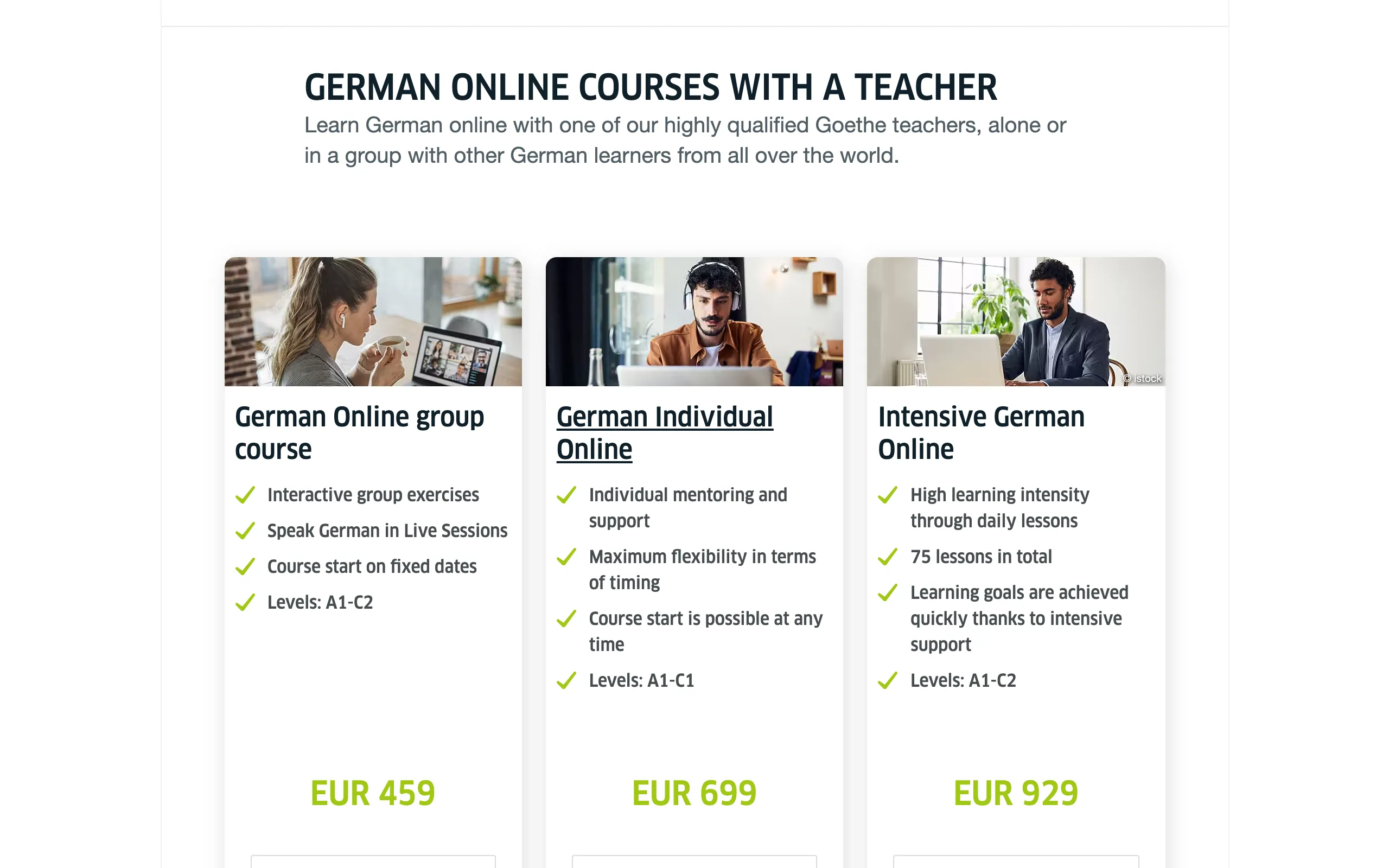
The price, and more pointedly, which country you pay it in. This is where the reports converge into something specific. Learners describe roughly 260 to 300 euros per level in Lithuania, India and Bulgaria, around 450 dollars in Hungary, 510 euros in Milan, and 1,500 dollars in the United States, with several people reacting to each other’s numbers in open disbelief. The institute’s own booking pages bear this out. In August 2026 the Germany institute listed a teacher-led online group course at 459 euros, one-to-one online at 699 and an intensive at 929. The American institute listed the equivalent online group course at 735 dollars and a super-intensive at 1,969.
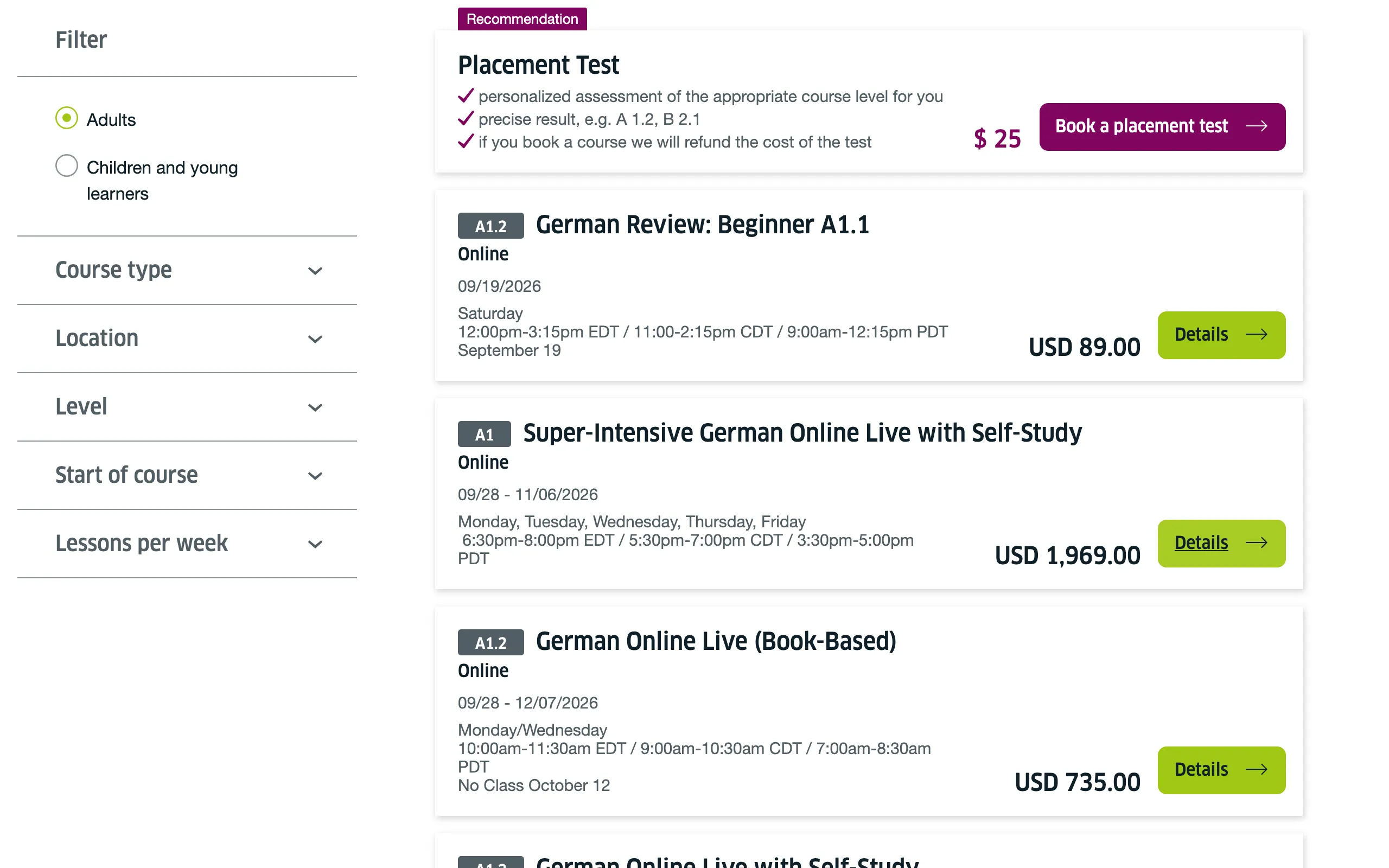
These are online courses, so the thing being bought is a video class and a login, not a building in a particular city. A few learners have worked this out and act on it, one taking Indian classes in a 7am local slot that suited their own timezone at roughly 300 dollars, another recommending the Indian institute outright at about 278 euros a level. The catch they mention is the timetable, which runs on the host country’s clock.
Inside Germany, the VHS undercuts it heavily. One learner got 200 hours for 350 euros with a teacher they rated highly. The C1 learner who left the Berlin course took 100 hours at the VHS for 150 euros and added a grammar course and a creative writing course on top. Several others make the same recommendation unprompted (r/German).
Class size changes the product, and it varies by branch. An A1.1 online class in Indonesia ran with 18 students who were split into breakout groups every few minutes with classmates as lost as they were, after which the teacher supplied the answer mostly in German. The same learner was not told in advance about a three-week break in the middle of the semester, and their advice is to ask the branch as many specific questions as possible before booking (r/German).
The online platform draws real complaints. One learner quit halfway through, describing constant breakout rooms, dead time either side of them, interface controls that had to be explained before they could be used, and a homework platform slow enough that exercises had to be redone when they failed to save. Their summary was that the German actually explained in a session would have fitted into a short video. Another calls the learning platform clunky and slow to load. A learner who finished a full A2 rated the quality and the materials well but could not get through most of the homework.
The self-study course expires, and this is the complaint that recurs most. Access runs three months from booking, which the institute states plainly on its own page. Learners consistently do not expect it. One lost their B2 material with an exam the following month. Another argues that three months is not enough to absorb a whole level and that you cannot come back to it later the way you would with anything else you study, which removes the option of spaced review. One says simply that books cost less, teach the same, and stay yours (r/German).
The self-study course has no speaking and thin vocabulary. The institute is upfront that the course targets listening and reading, handles writing through gap-fill, and does not practise speaking at all. Learners add the vocabulary problem: one at A2 found it taught very few words, with dated material and grammar that was not clearly explained, and an A1 learner in India described being pushed into building sentences after a couple of exercises having met only twenty or thirty words.
Fixed schedules that are set after you pay. One learner points out that the class time is settled between the group and the teacher once the course is booked, which is a problem if you work. Two live sessions a week is also less course than people expect: a learner at A1.2 who likes the course describes those sessions as the place to practise speaking and ask questions, with the actual studying happening on their own time.
Where learners genuinely disagree
Online against in person. One learner loved the in-person intensive and disliked the online version enough to warn people off it, describing online class as something closer to a sermon, where a remark either interrupts the teacher or waits in a queue until it is too weighty to make, and saying they built no rapport with anyone. They travel 45 minutes each way rather than repeat it. Against that, several learners rate the online classes without reservation, and one preferred the online platform to in-person classes at both the VHS and the Goethe-Institut, particularly while working full time (r/German).
Reading the accounts side by side, the thing that separates them is not the format but the number of people in the room. The unhappy online reports come with 18 students and constant breakouts. The happy ones come with five to nine. Nobody in these threads makes that connection themselves, and the institute does not advertise class size, so it is worth asking about before booking rather than after.
Whether it is worth paying for below B1. One camp says clearly not: A1 and A2 are the levels that are easiest to teach yourself, free structured courses cover them, and formal schooling starts to earn its price at B2 and C1. A common plan is to work through free material first and buy classes later. The other camp is made of people who started at A1 and are glad they did. One argues that going from nothing to modal verbs is a bigger jump than going from a little German to slightly more, and a learner who began at B1 says their only regret is not having done the lower levels there too (r/German).
Whether the self-study course is worth buying at all. One learner has bought it three times, rates the exercises highly for the price, would choose it over a book, and pairs it with an italki tutor for the speaking it does not cover. A learner who has taken both the self-study course and the teacher-led classes at B2 and C1 says the self-study product contains the same exercises without the teacher, the corrections or the speaking, and recommends it only as grammar revision. A third calls it a complete waste of money. What separates the enthusiasts is visible in the detail: they bought during a sale, at around half list price or less (r/German).
How people who rate it actually use it
- Check the price at more than one national institute before booking anything online. The same online course carries very different prices depending on which country’s site you book it from, and learners who noticed have saved a large multiple. Check the timetable is liveable in your timezone before committing.
- Ask how many students will be in the class. It is the variable that best predicts whether people rated their online course, and it is not published.
- Take a trial class first if the branch offers one. Several institutes run free online trial sessions, and the teacher is the part of this product that varies most.
- Self-teach A1 and A2 if you have the discipline, and start paying at B1. This is the most common piece of advice given by people who otherwise recommend the courses. Nicos Weg is the free structured course learners name for the lower levels, and it also stops at B1, which is roughly where this advice says to start paying.
- Treat the live sessions as speaking practice rather than as the course. Two sessions a week is not enough contact time to carry a level on its own, and the learners who are happy all describe substantial work outside class.
- Buy the self-study course only in a sale, and only as revision. Everyone who rates it bought it discounted, and the people who took both products describe it as the teacher-led course with the teacher removed.
- Price the VHS against it if you are in Germany. Learners who have used both put the hourly rates far apart, and several moved across after paying Goethe prices for a year.
Sources
- Is Goethe Institut online course (with a teacher) worth the money, r/German
- Is Goethe Institut worth it, r/German
- Anyone bought the online course of Goethe Institute, r/German
- Is Goethe Institut intensive course worth it, r/German
- Are the Goethe Institute online courses any good, r/German
- Did you do the Goethe Institut super intensive course, r/German
- German Online Courses, Goethe-Institut Germany
- Dates and prices, Goethe-Institut USA