Review
Babbel German review
Genuinely good grammar teaching at A1 and A2, then a B1 level roughly a sixth the size of A1, and nothing at all past B2.
Babbel is a subscription course app built around short lessons with written grammar explanations, dialogues, and a review feature that brings vocabulary back at intervals. One subscription covers all fourteen languages it offers. The German course is organised into CEFR levels and stops at B2, and the app is sold on plans from three months to a one-off lifetime payment. The levels are not built to the same size: A1 runs to more than ninety lessons and B1 to around fifteen.
Verdict. Babbel teaches beginner German better than the apps it competes with, then runs out of course at precisely the point German gets hard.
Best for beginners who want grammar explained rather than guessed at, and who expect to have outgrown the app by B1.
Less suitable for anyone already past A2, anyone who needs live speaking practice, or anyone expecting the upper levels to be built like the beginner ones.
At a glance
| Dimension | Band | Why |
|---|---|---|
| Course structure | Mixed | Well sequenced through A1 and A2, then thins out sharply from B1 |
| Grammar | Good | Explained in writing and exercised, which is the thing learners moving from other apps come for |
| Vocabulary | Good | Built steadily and brought back by the review feature, though the range stays practical |
| Reading | Mixed | Unit texts and dialogues exist, but nothing long enough to build reading on |
| Speaking | Weak | Pronunciation checking only, since the live classes closed to individual subscribers |
| Writing | Weak | Little independent production asked for at any level |
| Listening | Unknown | Learners rate the dialogues, but nobody reports on listening as an outcome |
| Value | Mixed | The beginner half earns the money; the upper levels cost the same and deliver far less |
The course is sold as running to B2. These bands describe a well-built A1 and A2 and very little after that.
What learners consistently praise
Grammar is explained, and that is the reason people move here. It is the most consistent praise and it almost always comes as a comparison. A learner who used both described Babbel as considerably better than Duolingo at explaining grammar. A native speaker who has used it across several languages called it textbook-like: explanations, exercises, unit texts and dialogues, with the flashcards an optional extra rather than the substance (r/German).
The sequencing at beginner level is the thing people pay for. Learners describe it as better structured than the free apps, introducing and reinforcing concepts in an order that holds, and checking pronunciation as it goes. One set it against the disconnected sentence fragments of the gamified apps: here the emphasis falls on conversations (r/German).
It suits people with very little time and very little energy. A learner in the final year of a doctorate, moving to Germany and studying around heavy work, chose it as the lowest-effort option: fifteen minutes a day, no study session to plan first. Learners recommending free alternatives did not dispute the advantage (r/German).
A learner who finished the Duolingo course and moved across found genuinely new material, and rated the German content non-redundant rather than a re-run of what they already had (r/German).
What learners consistently criticise
The B1 level is a fraction of the size of A1, and learners keep discovering it the same way. One learner near the end of A1 looked ahead and counted about fifteen lessons in the whole of B1, against more than ninety in A1 (r/German). Another, working towards a job application, counted fourteen and assumed they were misreading the app (r/German). A third spent months on A2, then hit the halfway point of B1 in a fortnight, and found that material not just shorter but easier than the A2 before it (r/German).
Set against what the levels actually cost in study time, the shape of the problem is clear. A C1 learner supplied the comparison: government-funded courses in Germany take around 600 hours of class time to reach B1, roughly 200 per sublevel, homework excluded. CEFR levels get larger as they go up. This course gets smaller.
There is nothing after B2, and B2 itself is thin. A learner who finished the B2 material went looking for what came next and found nothing, while being clear they were not at B2 themselves. Someone asking whether to continue at B2 or C1 was told flatly, by other learners and a German teacher, that there is nothing above it (r/German).
The live classes closed to individual subscribers, mid-subscription for some. Babbel Live carried the speaking practice, and learners rated the teaching. One had subscribed for a year specifically for it and lost it partway through (r/German). It survives only as a business product. Learners in the same discussions report features being removed and simplified over time, and rate the customer service poorly.
Output is barely exercised. A learner at B1 put the ceiling plainly: grammar and vocabulary handled adequately, very little for reading, writing or speaking, and an end point around tourist-level speech.
It will not get you through a Goethe A1 exam. A learner who needed the A1 certificate for a German residence permit reported the app’s A1 material as well below the standard of the official course and exam. This matters more than a general quality complaint, because certificate deadlines are the reason a lot of people start paying.
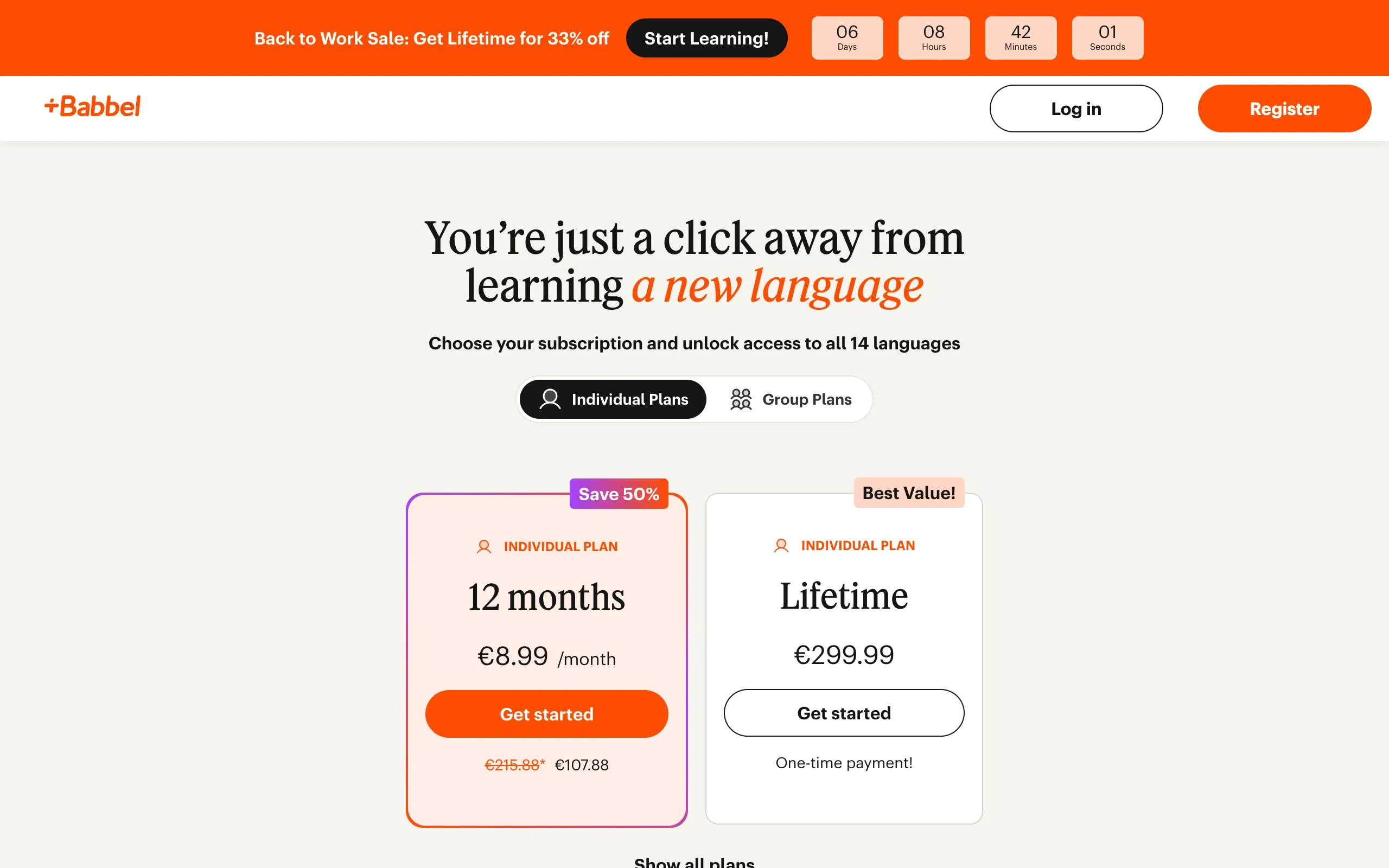
What you pay depends mostly on when you happen to arrive. The plans run from three months at €17.99 a month to a lifetime payment of €299.99, with a twelve-month plan at €8.99 a month. The advertised saving is calculated against a reference price. Babbel’s own footnote defines that reference as the cost of running the three-month plan for the same period: the most expensive way to buy, not a price the product ever charged. A countdown clock runs above it. Learners have worked this out and pass the advice around, which is to wait for a sale. One bought a lifetime subscription during one for less than two years of a rival’s paid tier.
Where learners genuinely disagree
Learners cannot agree on what the product even is. A learner at B2 described it as flashcards with spaced repetition, and set it against a real course covering grammar and culture. A native speaker in the same discussion described almost the opposite: grammar explanations, exercises, unit texts and dialogues, with the flashcards as an optional side feature they had never bothered with.
Both hedged identically: this was how it worked when they used it. Learners elsewhere report features being changed, removed and simplified over time. The disagreement is probably about dates rather than about the product. An account of Babbel is only as current as the subscription it came from.
Whether the beginner levels justify the price at all. Learners who rate it are buying the sequencing and the explanations, and say a course map you can follow without planning is worth real money when time is short. Learners who disagree point at Nicos Weg and the Volkshochschule portal, both free, both structured, one of them running to B2. A learner who used Babbel for seven or eight months, broke off, and came back found the free course suited them better, and could not work out why the paid one was worse (r/German). Nobody in that exchange resolved it, though a native speaker made the point that the price of a resource tells you very little about its value.
How people who rate it actually use it
- Come to it from a gamified app, at the point grammar starts mattering. The pattern learners describe is starting free, hitting the wall where guessing at patterns stops working, and paying for explanations. That is the transition this course is best at.
- Buy on a sale, or buy lifetime on a sale. Learners pass this around as standard advice, and one bought a lifetime subscription for less than two years of a competitor’s subscription.
- Line up what comes after B1 before you get there. The learners who were most disappointed were the ones who discovered the drop-off from inside it. Free structured courses run to B1 and B2. Above that, learners move to tutors or a school; one noted Babbel Live’s monthly price had climbed to roughly what the Goethe-Institut charges for a group course, which settled it.
- Arrange speaking separately, because the app no longer supplies it. With the live classes gone for individual learners, the remaining speaking feature is pronunciation checking.
- Do not treat it as exam preparation. Learners aiming at Goethe certificates add sample papers, a textbook or a course. Those who tested the app’s beginner material against the real exam found a gap.
Sources
- Completely underwhelmed by Babbel B1 course, r/German
- Why is Babbel German B1 so short, r/German
- How realistic is Babbel’s level system, r/German
- Nicos Weg is better than Babbel, am I crazy, r/German
- Babbel to discontinue Live classes at the end of June, r/German
- Babbel for advanced, r/German
- Which has more content, Duolingo or Babbel, r/German
- Babbel while living in Germany with family, r/German
- Looking for a structured German course alternative to Babbel, r/German
- How good is babbel.com as a source to learn German, r/German